

No Result
View All Result
DevRescue
  • Home
  • Python
  • Lists
  • Movies
  • Finance
  • Opinion
  • About
  • Contact Us
  • Home
  • Python
  • Lists
  • Movies
  • Finance
  • Opinion
  • About
  • Contact Us
DevRescue
Home Blog Python

Python regex for IP Address

by Khaleel O.
February 1, 2022
in Python
Reading Time: 4 mins read
A A
Python regex for IP Address

Let’s use Python regex to validate an IP address. Let’s go!

Regex is short for “regular expression”. A regular expression is a pattern, defined in Python code, that will be compared to a target string for matches. In the following example, we will write some code to detect and validate IP addresses using regular expressions:


import re

ip ="255.255.255.0"

validip = re.match(r"^(([0-9]|[1-9][0-9]|1[0-9]{2}|2[0-4][0-9]|25[0-5])\.){3}([0-9]|[1-9][0-9]|1[0-9]{2}|2[0-4][0-9]|25[0-5])$",ip)

print(validip.group())

#output
#255.255.255.0

Let’s explain what is happening here:

  1. First we import the regular expression module re.
  2. We define the ip address value to be tested for a match ip.
  3. We use a regular expression defined as the pattern parameter of the re.match() function. This complex looking regular expression pattern will only match valid IPv4 IP addresses.
  4. We print the matching group if it exists.

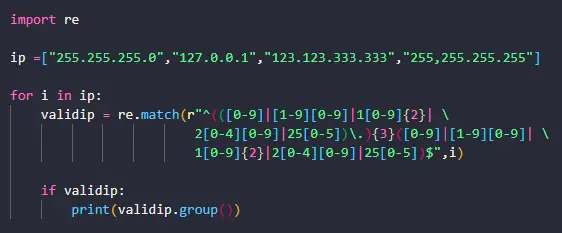
If the above executes, you should see the matching IP address printed to the screen. Let’s do another case, this time let’s try a few more examples, even invalid ones:

import re

ip =["255.255.255.0","127.0.0.1","123.123.333.333","255,255.255.255"]

for i in ip:
    validip = re.match(r"^(([0-9]|[1-9][0-9]|1[0-9]{2}|2[0-4][0-9]|25[0-5])\.){3}([0-9]|[1-9][0-9]|1[0-9]{2}|2[0-4][0-9]|25[0-5])$",i)
    
    if validip:
        print(validip.group())


#output
#255.255.255.0
#127.0.0.1

All the same steps except that we are seeking to match the elements of a list this time. The elements of the list ip contain both valid and invalid IP addresses. The regex should only match valid IP addresses for IPv4 type addresses. So we try to match each element in a loop against our regex pattern defined in the re.match() function. This time we only get two valid IP addresses.

We can do something similar to validate IPv6 type IP addresses. See the code below:

import re

ipv6 = ["2001:db8:3333:4444:5555:6666:7777:8888","2001:db8:3333:4444:CCCC:DDDD:EEEE:FFFF","2001:db8:3333:4444:CCCC:DDDD:EEEE:ZZZZ","192:168:100:100"]

for i in ipv6:

    validip = re.match(r'^(?:(?:[0-9A-Fa-f]{1,4}:){6}(?:[0-9A-Fa-f]{1,4}:[0-9A-Fa-f]{1,4}| \
                            (?:(?:[0-9]|[1-9][0-9]|1[0-9]{2}|2[0-4][0-9]|25[0-5])\\.){3}(?:[0-9]|[1-9][0-9]|1[0-9]{2}|2[0-4][0-9]|25[0-5]))| \
                                ::(?:[0-9A-Fa-f]{1,4}:){5}(?:[0-9A-Fa-f]{1,4}:[0-9A-Fa-f]{1,4}|(?:(?:[0-9]|[1-9][0-9]|1[0-9]{2}|2[0-4][0-9]| \
                                    25[0-5])\\.){3}(?:[0-9]|[1-9][0-9]|1[0-9]{2}|2[0-4][0-9]|25[0-5]))| \
                                    (?:[0-9A-Fa-f]{1,4})?::(?:[0-9A-Fa-f]{1,4}:){4}(?:[0-9A-Fa-f]{1,4}:[0-9A-Fa-f]{1,4} \
                                        |(?:(?:[0-9]|[1-9][0-9]|1[0-9]{2}|2[0-4][0-9]|25[0-5])\\.){3}(?:[0-9]|[1-9][0-9]|1[0-9]{2}| \
                                            2[0-4][0-9]|25[0-5]))|(?:[0-9A-Fa-f]{1,4}:[0-9A-Fa-f]{1,4})?::(?:[0-9A-Fa-f]{1,4}:){3}(?:[0-9A-Fa-f]{1,4}:[0-9A-Fa-f]{1,4}| \
                                                (?:(?:[0-9]|[1-9][0-9]|1[0-9]{2}|2[0-4][0-9]|25[0-5])\\.){3}(?:[0-9]|[1-9][0-9]|1[0-9]{2}|2[0-4][0-9]|25[0-5]))| \
                                                    (?:(?:[0-9A-Fa-f]{1,4}:){,2}[0-9A-Fa-f]{1,4})?::(?:[0-9A-Fa-f]{1,4}:){2}(?:[0-9A-Fa-f]{1,4}:[0-9A-Fa-f]{1,4}| \
                                                        (?:(?:[0-9]|[1-9][0-9]|1[0-9]{2}|2[0-4][0-9]|25[0-5])\\.){3}(?:[0-9]|[1-9][0-9]|1[0-9]{2}|2[0-4][0-9]|25[0-5]))| \
                                                            (?:(?:[0-9A-Fa-f]{1,4}:){,3}[0-9A-Fa-f]{1,4})?::[0-9A-Fa-f]{1,4}:(?:[0-9A-Fa-f]{1,4}:[0-9A-Fa-f]{1,4}|(?:(?:[0-9]| \
                                                                [1-9][0-9]|1[0-9]{2}|2[0-4][0-9]|25[0-5])\\.){3}(?:[0-9]|[1-9][0-9]|1[0-9]{2}|2[0-4][0-9]|25[0-5]))| \
                                                                    (?:(?:[0-9A-Fa-f]{1,4}:){,4}[0-9A-Fa-f]{1,4})?::(?:[0-9A-Fa-f]{1,4}:[0-9A-Fa-f]{1,4}|(?:(?:[0-9]|[1-9][0-9]| \
                                                                        1[0-9]{2}|2[0-4][0-9]|25[0-5])\\.){3}(?:[0-9]|[1-9][0-9]|1[0-9]{2}|2[0-4][0-9]|25[0-5]))| \
                                                                            (?:(?:[0-9A-Fa-f]{1,4}:){,5}[0-9A-Fa-f]{1,4})?::[0-9A-Fa-f]{1,4}|(?:(?:[0-9A-Fa-f]{1,4}:){,6}[0-9A-Fa-f]{1,4})?::)$',i)

    if validip:
        print(validip.group())

#output
#2001:db8:3333:4444:5555:6666:7777:8888
#2001:db8:3333:4444:CCCC:DDDD:EEEE:FFFF

So validating IPv6 addresses is a bit more tricky. Because the ip address is 128-bits as opposed to the 32-bit IPv4 address, there are more possibilities and consequently the pattern needs to be adjusted to handle more eventualities. This is why it is so much longer.

Neat right? Thanks for reading! ๐Ÿ”ฅ๐Ÿ”ฅ๐Ÿ”ฅโœจโœจ


Are you worried about your child’s online safety or your employees’ productivity? Do you wonder what they’re accessing on their devices? SentryPC is here to address these concerns. This all-in-one, cloud-based software provides robust activity monitoring, content filtering, and time management, making it ideal for both parental control and employee monitoring. Embrace peace of mind and enhanced efficiency with SentryPC, the proactive solution to your digital monitoring needs. CLICK HERE to get started.

Previous Post

Python regex Match Groups

Next Post

Python pytrends Line Chart Tutorial

Khaleel O.

Khaleel O.

I love to share, educate and help developers. I have 14+ years experience in IT. Currently transitioning from Systems Administration to DevOps. Avid reader, intellectual and dreamer. Enter Freely, Go safely, And leave something of the happiness you bring.

Related Posts

Python

Python Fibonacci Recursive Solution

by Khaleel O.
January 16, 2024
0
0

Let's do a Python Fibonacci Recursive Solution. Let's go! ๐Ÿ”ฅ๐Ÿ”ฅ๐Ÿ”ฅ The Fibonacci sequence is a series of numbers in which...

Read moreDetails
Python

Python Slice String List Tuple

by Khaleel O.
January 16, 2024
0
0

Let's do a Python Slice string list tuple how-to tutorial. Let's go! ๐Ÿ”ฅ๐Ÿ”ฅ๐Ÿ”ฅ In Python, a slice is a feature...

Read moreDetails
Python

Python Blowfish Encryption Example

by Khaleel O.
January 14, 2024
0
0

Let's do a Python Blowfish Encryption example. Let's go! ๐Ÿ”ฅ ๐Ÿ”ฅ Blowfish is a symmetric-key block cipher algorithm designed for...

Read moreDetails
Python

Python Deque Methods

by Khaleel O.
January 14, 2024
0
0

In this post we'll list Python Deque Methods. Ready? Let's go! ๐Ÿ”ฅ๐Ÿ”ฅ๐Ÿ”ฅ A deque (double-ended queue) in Python is a...

Read moreDetails

DevRescue ยฉ 2021 All Rights Reserved. Privacy Policy. Cookie Policy

Manage your privacy

To provide the best experiences, we and our partners use technologies like cookies to store and/or access device information. Consenting to these technologies will allow us and our partners to process personal data such as browsing behavior or unique IDs on this site and show (non-) personalized ads. Not consenting or withdrawing consent, may adversely affect certain features and functions.

Click below to consent to the above or make granular choices. Your choices will be applied to this site only. You can change your settings at any time, including withdrawing your consent, by using the toggles on the Cookie Policy, or by clicking on the manage consent button at the bottom of the screen.

Functional Always active
The technical storage or access is strictly necessary for the legitimate purpose of enabling the use of a specific service explicitly requested by the subscriber or user, or for the sole purpose of carrying out the transmission of a communication over an electronic communications network.
Preferences
The technical storage or access is necessary for the legitimate purpose of storing preferences that are not requested by the subscriber or user.
Statistics
The technical storage or access that is used exclusively for statistical purposes. The technical storage or access that is used exclusively for anonymous statistical purposes. Without a subpoena, voluntary compliance on the part of your Internet Service Provider, or additional records from a third party, information stored or retrieved for this purpose alone cannot usually be used to identify you.
Marketing
The technical storage or access is required to create user profiles to send advertising, or to track the user on a website or across several websites for similar marketing purposes.
Statistics

Marketing

Features
Always active

Always active
  • Manage options
  • Manage services
  • Manage {vendor_count} vendors
  • Read more about these purposes
Manage options
  • {title}
  • {title}
  • {title}
Manage your privacy
To provide the best experiences, DevRescue.com will use technologies like cookies to store and/or access device information. Consenting to these technologies will allow us to process data such as browsing behavior or unique IDs on this site. Not consenting or withdrawing consent, may adversely affect certain features and functions.
Functional Always active
The technical storage or access is strictly necessary for the legitimate purpose of enabling the use of a specific service explicitly requested by the subscriber or user, or for the sole purpose of carrying out the transmission of a communication over an electronic communications network.
Preferences
The technical storage or access is necessary for the legitimate purpose of storing preferences that are not requested by the subscriber or user.
Statistics
The technical storage or access that is used exclusively for statistical purposes. The technical storage or access that is used exclusively for anonymous statistical purposes. Without a subpoena, voluntary compliance on the part of your Internet Service Provider, or additional records from a third party, information stored or retrieved for this purpose alone cannot usually be used to identify you.
Marketing
The technical storage or access is required to create user profiles to send advertising, or to track the user on a website or across several websites for similar marketing purposes.
Statistics

Marketing

Features
Always active

Always active
  • Manage options
  • Manage services
  • Manage {vendor_count} vendors
  • Read more about these purposes
Manage options
  • {title}
  • {title}
  • {title}
No Result
View All Result
  • Home
  • Python
  • Lists
  • Movies
  • Finance
  • Opinion
  • About
  • Contact Us

DevRescue ยฉ 2022 All Rights Reserved Privacy Policy